Updated: September 5, 2003
NANOGOLD® PRODUCT INFORMATION
Ni-NTA-Nanogold®
| Product Name: |
Nickel (II) Nitrilotriacetic acid (NTA)- Nanogold® |
| Catalog Number: |
2001, 2080 |
| Storage:: |
Upon receipt store product at 2 - 8°C. Product is shipped at ambient temperature. |
| Revision: |
1.0 (August 2003) |
Technical Assistance Online
Instructions (PDF)
Material Safety Data Sheet (PDF)
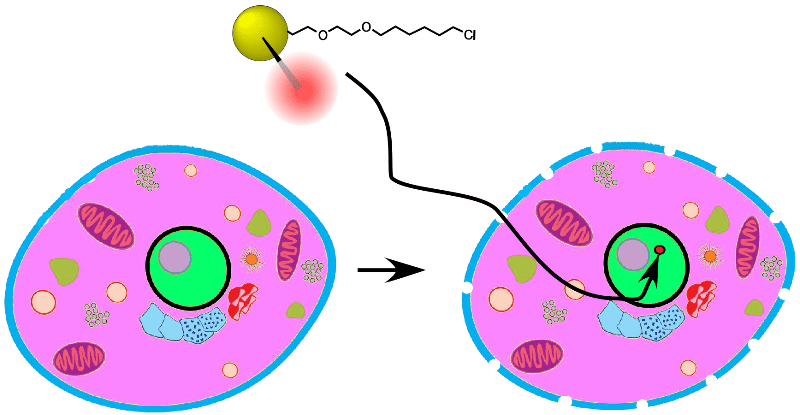
Ni-NTA-Nanogold® is designed for detection or localization of polyhistidine (his) -tagged fusion proteins using electron microscopy, light microscopy or blotting. Using Ni-NTA-Nanogold®, his-tagged fusion proteins originating from any of a variety of expression vectors can be labeled under non-denaturing or denaturing conditions. The labeled his-tagged fusion proteins can be visualized by microscope or blots, when used with gold or silver enhancement reagents such as our Gold Enhance EM (Catalog number 2113), Gold Enhance LM (Catalog number 2112), or HQ Silver (Catalog Number 2012).
Warning: For research use only. Not recommended or intended for diagnosis of disease in humans or animals. Do not use internally or externally in humans or animals. Non radioactive and non carcinogenic.
The His-tag, consisting of five to ten consecutive histidine residues, has been used for several years for purification of proteins by immobilized metal-ion affinity chromatography (IMAC).1-3 The use of a His tag has several advantages. There is minimal addition of extra amino acids to the recombinant proteins. The small histidine tail is poorly immunogenic and usually does not interfere with protein folding. His-tagged proteins can have an extremely high affinity for metal ions (up to Ka=1013 M).1,4-6 This affinity for metal ions allows for the detection of the fusion proteins using Ni-NTA (nickel-nitrilotriacetic acid) based methods such as Ni-NTA-Nanogold® (Catalog Number 2080).7 Ni-NTA-Nanogold® consists of a 1.8 nm Nanogold particle with multiple nickel-nitrilotriacetic acid functionalities incorporated into the ligands on the surface of gold particles. Each Ni2+ coordinates with one nitrilotriacetic acid and two histidines from the fusion proteins to form a stable complex (Figure 1). The his-tagged fusion proteins are therefore labeled, and detected by electron microscopy, light microscopy or blotting, when used with appropriate Gold or Silver enhance reagents.
Contents
Figure 1: Interaction between a His-tagged protein and Ni-NTA-Nanogold®.
This product is supplied as a brown colored liquid with a concentration of 10 nmol/ml of Ni-NTA-Nanogold® in 50 mM MOPs, pH 7.9. No additional stabilizer or preservative is included. If a sterile solution is needed, filter the product with a 0.2 micron cellulose acetate membrane filter. As supplied, this product is stable at least 1 year when stored at 2 - 8°C.
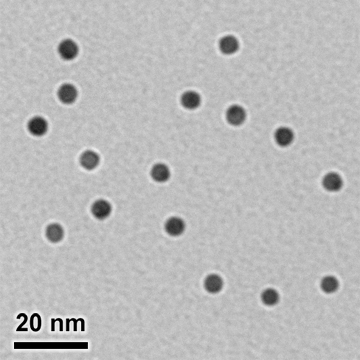
- NANOGOLD® is an extremely uniform 1.4 nm diameter gold particle (ca.10%).
- For best results, prepare sample in a weak buffer at pH 7.0-8.0. The sample must be free of thiols such as beta-mercaptoethanol, reducing or chelating agents such as DTT, EDTA or citrate. Samples containing EDTA, DTT, or citrate may give low specific staining.
- Before applying Ni-NTA-Nanogold®, block the sample with 20 mM Tris, 150 mM NaCl, 0.05% Tween 20 at pH 7.6 containing 1-5 % BSA or Nonfat dry milk for 5-30 min at room temperature. The blocking step can block some non-specific protein binding sites and minimizes non-specific interaction.
- Incubate the sample with Ni-NTA-Nanogold®, diluted 1/5 – 1/100 in 20 mM Tris, 150 mM NaCl, 1% BSA or nonfat dry milk, 0.05% Tween 20 at pH 7.6, for 5 -30 min at room temperature. The optimum quantity of Ni-NTA-Nanogold® to be used needs to be determined for each application since his-tagged proteins when saturating the gold will prevent binding of weakly interacting proteins. For most applications, 5-10 min incubation is sufficient for obtaining a positive staining.
- After the application of Ni-NTA-Nanogold®, wash the sample with a buffer containing 50 mM Tris, 300 mM NaCl, 10-200 mM imidazole and 0.05% Tween 20 adjusted to pH7.6. The wash buffer may be optimized for specific applications by adjusting the imidazole and NaCl (up to 1M) concentration. Increasing the imidazole concentration helps to reduce the non-specific interaction or background, and can also decease the binding to the target proteins. To determine the optimal combination of specific staining and background, different wash conditions should be tested
- The Ni-NTA procedure can also be used under denaturing conditions. This can be useful in cases where the his-tag is inaccessible from the surface of the fusion proteins or if the protein is insoluble.
- Buffers other than the suggested ones can be used if similar pH and ionic strength are used. Low pH (<5.0) protonate the histidines, and disrupts their interaction with the metal.
- For most work, gold or silver enhancement with a neutral pH is recommended to give a good signal in the electron or light microscope and blots. The enhancement can be terminated by immersion of the sample in 2.5 % of sodium thiosulfate for 1 min as soon as satisfactory specific staining is reached. Further enhancement may lead undesirable background. Applying gold or silver enhancement to a control sample without exposing to Ni-NTA-Nanogold® helps to determine the stability time when self-nucleation starts. Self-nucleation can generate high background. The actual enhancement time should never exceed the stability time.
- Because the 1.8 nm Nanogold® particles are small, over-staining with OsO4, uranyl acetate or lead citrate may tend to obscure direct visualization of individual Nanogold® particles. Therefore, the use of reduced amount or concentration of usual stains is recommended.
| PBS |
A buffer containing 20 mM phosphate and 150 mM NaCl adjusted to pH 7.4. |
| TBST-BSA |
A buffer containing 20 mM Tris, 150 mM NaCl, 1% BSA (or nonfat dry milk), and 0.05% Tween 20 adjusted to pH 7.6 |
| TBST-imidazole |
A buffer containing 50 mM Tris, 300 mM NaCl, 50 mM imidazole and 0.05 % Tween 20 adjusted to pH 7.6 |
Contents
If aldehyde-containing reagents have been used for fixation, these must be quenched before labeling. This may be achieved by incubating the specimens for 5 minutes in 50 mM glycine solution in PBS. Ammonium chloride (50 mM) or sodium borohydride (0.5 - 1 mg/ml) in PBS may be used instead of glycine.
- Optional fixing of cells: e.g., with glutaraldehyde (0.05 - 1% for 15 minutes) in PBS. Do not use Tris buffer in this step since it contains an amine. After fixation, centrifuge cells (e.g. 1 ml at 107 cells/ml) at 300 X g, 5 minutes; discard supernatant; resuspend in 1 ml buffer. Repeat this washing (centrifugation and resuspension) 2 times.
- Incubate cells with 0.02 M glycine in PBS (5 mins). Centrifuge, then resuspend cells in TBST-BSA buffer for 5 minutes.
- Wash cells using TBST-BSA as described in step 1 (2 X 5 mins). Resuspend in 1 ml TBST-BSA.
- Place 50 - 200 microliters of cells into Eppendorf tube. Dilute Ni-NTA- Nanogold® ~50 times in TBST-BSA buffer and add 30 microliters to cells; incubate for 5 minutes with occasional shaking.
- Wash cells in TBST-imidazole as described in step 1 (3 X 5 mins).
- Fix cells using a final concentration of 1% glutaraldehyde in PBS for 15 minutes. Then remove fixative by washing with PBS (3 X 5 mins).
Negative staining may be used for electron microscopy of small structures or single molecules which are not embedded. Negative stain must be applied after the silver enhancement. NanoVan® negative stain is specially formulated for use with Nanogold® reagents; it is based on vanadium, which gives a lighter stain than uranium, lead or tungsten-based negative stains and allows easier visualization of Nanogold® particles with little or no silver enhancement.8
Contents
Labeling with Nanogold® may be performed before or after embedding8,9. Labeling before embedding and sectioning (the pre-embedding method)8,9 is used for the study of surface antigens, particularly small organisms such as viruses budding from host cells. It gives good preservation of cellular structure, and subsequent staining usually produces high contrast for study of the cellular details. Labeling after embedding and sectioning (the post-embedding method) allows the Ni-NTA-Nanogold® access to the interior of the cells, and is used to label both exterior and interior features.9,10 The procedures for both methods are described below.
Thin sections mounted on grids are floated on drops of solutions on parafilm or in well plates. Hydrophobic resins usually require pre-etching.
PROCEDURE FOR PRE-EMBEDDING METHOD9
- Float on a drop of water for 5 - 10 minutes.
- Incubate cells with TBST-BSA for 5 minutes; this blocks any non-specific protein binding sites and minimizes non-specific binding.
- Rinse with TBST-BSA (1 min).
- Incubate with Ni-NTA-Nanogold® diluted 1/50 in TBST-BSA for 5 min at room temperature.
- Rinse with TBST-imidazole (3 X 5 min), then PBS (3 X 1 min).
- Postfix with 1 % glutaraldehyde in PBS (10 mins).
- Rinse in deionized water (2 X 5 min).
- Dehydrate and embed according to usual procedure. Use of a low-temperature resin (e.g. Lowicryl) is recommended.
- Stain (uranyl acetate, lead citrate or other positive staining reagent) as usual before examination.
Gold or Silver enhancement may be performed before or after embedding (see below); it should be completed before postfixing or staining with osmium tetroxide, uranyl acetate or similar reagents is carried out.
PROCEDURE FOR POST-EMBEDDING METHOD9
- Prepare sections on plastic or carbon-coated nickel grid. Float on a drop of water for 5 - 10 minutes.
- Incubate with TBST-BSA for 5 minutes to block non-specific protein binding sites.
- Rinse with TBSTS-BSA (1 min).
- Incubate with Ni-NTA-Nanogold® diluted 1/50 in TBST-BSA for 5 minutes at room temperature.
- Rinse with TBST-imidazole (3 X 5 min), then PBS (3 X 1 min).
- Postfix with 1 % glutaraldehyde in PBS at room temperature (3 mins).
- Rinse in deionized water for (2 X 5 min).
- If desired, contrast sections with uranyl acetate and/or lead citrate before examination.
Gold or Silver enhancement may also be used to render the Nanogold® particles more easily visible (see below), especially if stains such as uranyl acetate or lead citrate are applied. If used, it should be completed before these satins are applied.
Contents
For most work, gold or silver enhancement is recommended to give a good signal in the electron microscope (see below). For particular applications, visualization of the Nanogold® directly may be desirable. Generally this requires very thin samples and precludes the use of other stains.
Nanogold® provides a much improved resolution and smaller probe size over other colloidal gold antibody products. However, because Nanogold® is only 1.8 nm in diameter, it will not only be smaller, but will appear less intense than, for example, a 5 nm gold particle. With careful work, however, Nanogold® may be seen directly through the binoculars of a standard EM even in 80 nm thin sections. However, achieving the high resolution necessary for this work may require new demands on your equipment and technique. Several suggestions follow:
- Before you start a project with Nanogold® it is helpful to see it so you know what to look for. Dilute the Nanogold® stock 1:5 and apply 4 microliters to a grid for 1 minute. Wick the drop and wash with deionized water 4 times.
- View Nanogold® at 100,000 X magnification with 10 X binoculars for a final magnification of 1,000,000 X. Turn the emission up full and adjust the condenser for maximum illumination.
- The alignment of the microscope should be in order to give 0.3 nm resolution. Although the scope should be well aligned, you may be able to skip this step if you do step 4.
- Objective stigmators must be optimally set at 100,000 X. Even if the rest of the microscope optics is not perfectly aligned, adjustment of the objective stigmators may compensate and give the required resolution. You may want to follow your local protocol for this alignment but since it is important, a brief protocol is given here:
- At 100,000 X (1 X 106 with binoculars), over focus, under focus, then set the objective lens to in focus. This is where there is the least amount of detail seen.
- Adjust each objective stigmator to give the least amount of detail in the image.
- Repeat steps a and b until the in focus image contains virtually no contrast, no wormy details, and gives a flat featureless image.
- Now underfocus slightly, move to a fresh area, and you should see small black dots of 1.8 nm size. This is the Nanogold®. For the 1:5 dilution suggested, there should be about 5 to 10 gold spots on the small viewing screen used with the binoculars. Contrast and visibility of the gold clusters is best at 0.2 - 0.5 m defocus, and is much worse at typical defocus values of 1.5 - 2.0 m commonly used for protein molecular imaging.
- In order to operate at high magnification with high beam current, thin carbon film over fenestrated holey film is recommended. Alternatively, thin carbon or 0.2% Formvar over a 1000 mesh grid is acceptable. Many plastic supports are unstable under these conditions of high magnification/high beam current and carbon is therefore preferred. Contrast is best using thinner films and thinner sections.
- Once you have seen Nanogold® you may now be able to reduce the beam current and obtain better images on film. For direct viewing with the binoculars reduction in magnification from 1,000,000 X to 50,000 X makes the Nanogold® much more difficult to observe and not all of the golds are discernable. At 30,000 X (300,000 X with 10 X binoculars) Nanogold® particles are not visible. It is recommended to view at 1,000,000 X, with maximum beam current, align the objective stigmators, and then move to a fresh area, reduce the beam, and record on film.
- If the demands of high resolution are too taxing or your sample has an interfering stain, a very good result may be obtained using gold or silver enhancement to give particles easily seen at lower magnification.
Contents
Nanogold® will nucleate gold or silver deposition resulting in a dense particle 2-80 nm in size or larger depending on development time. If specimens are to be embedded, gold or silver enhancement is usually performed after embedding, although it may be done first. It must be completed before applying any staining reagents such as osmium tetroxide, lead citrate or uranyl acetate are applied, since these will nucleate gold or silver deposition in the same manner as gold and produce non-specific staining. With Nanogold® reagents, low-temperature resins (e.g. Lowicryl) should be used and the specimens kept at room temperature until after gold or silver development has been completed. Gold or silver development is recommended for applications of Nanogold® in which these stains are to be used, otherwise the Nanogold® particles may be difficult to visualize against the stain.
Specimens must be thoroughly rinsed with deionized water before silver enhancement reagents are applied. This is because the buffers used may contain chloride ions and other anions which form insoluble precipitates with silver. These are often light-sensitive and will give non-specific staining.
Fixing with osmium tetroxide may cause some loss of silver; if this is found to be a problem, slightly longer development time may be appropriate. Alternatively, use of 0.1 % osmium tetroxide instead of 1 % has been found to give similar levels of staining while greatly reducing etching of the silver particles.
NOTE: Treatment with osmium tetroxide followed by uranyl acetate staining can lead to much more drastic loss of the silver enhanced Nanogold® particles. This may be prevented by gold toning11
- After silver enhancement, wash thoroughly with deionized water.
- 0.05 % gold chloride: 10 minutes at 4°C.
- Wash with deionized water.
- 0.5 % oxalic acid: 2 mins at room temperature.
- 1 % sodium thiosulfate (freshly made) for 1 hour.
- Wash thoroughly with deionized water and embed according to usual procedure.
Contents
Features labeled with Nanogold® will be stained black in the light microscope upon gold or silver enhancement. Different development time should be tried to determine which is best for your experiment. The labeling procedure is similar to that for EM; an example procedure is given below.
Samples must be rinsed with deionized water before silver enhancement. This is because the reagent contains silver ions in solution, which react to form a precipitate with chloride, phosphate and other anions which are components of buffer solutions.
- Spin cells onto slides using Cytospin, or use paraffin section.
- Incubate with TBST-BSA to block non-specific protein binding sites.
- Rinse with TBST-BSA (3 X 2 min).
- Incubate with Ni-NTA-Nanogold® diluted 1/50 in TBST-BSA for 5 minutes at room temperature.
- Rinse with TBST-imidazole (3 X 5 min), then PBS (3 X 1 min).
- Postfix with 1 % glutaraldehyde in PBS at room temperature (3 mins).
- Rinse with deionized water (3 X 1 min).
- Perform gold or silver enhancement according to manufacturer’s instruction.
- Rinse with deionized water (2 X 5 mins).
- The specimen may now be stained if desired before examination, with usual reagents.
Contents
The basic procedure for gold blotting has been described by Moeremans et al12 which may be followed. The procedure for dot blots is as follows:
- Spot 1 microliter dilutions of his-tagged protein solution onto nitrocellulose membrane. Use an protein concentration ranging from 1 mg/ml to 0.0001 mg/ml
- Block with 20 mM Tris, 150 mM NaCl, 5% nonfat dry milk, and 0.05 % Tween 20 adjusted to pH7.6 for 30 minutes at room temperature
- Rinse with 20 mM Tris, 150 mM NaCl and 0.05 % Tween 20 (3 X 5 mins).
- Incubate with Ni-NTA-Nanogold® diluted 1/50 in 20 mM Tris, 150 mM NaCl, 1% nonfat dry milk, and 0.05 % Tween 20 adjusted to pH7.6 for 5 mins at room temperature.
- Rinse with TBST-imidazole (3 X 5 min)
- Rinse with deionized water (4 X 3 mins).
- Perform gold or silver enhancement as directed in the instructions for gold or silver reagent
- Stop the enhancement by immersion of the membrane in 2.5 % aqueous solution of sodium thiosulfate for 1 min
- Rinse the membrane thoroughly with water and air dry it
Contents
- Hochuli, E.; Bannwarth, W.; Dobeli H.; Gentz, R., and Stuber, D.: Genetic approach to facilitate purification of recombinant proteins with a novel metal chelate adsorbent. Bio/Technology, 6, 1321-1325 (1988).
- Porath, J, and Olin, B.: Immobilized metal ion affinity adsorption and immobilized metal ion affinity chromatography of biomaterials. Serum protein affinities for gel-immobilized iron and nickel ions. Biochemistry, 22, 1621-1630 (1983).
- Hochuli, E.; Dobeli H, Schacher A. New metal chelate adsorbent selective for proteins and peptides containing neighbouring histidine residues. J. Chromatograph., 411, 177-184 (1987).
- Uhlen, M., and Moks, T: Gene fusions for purpose of expression: an introduction. Methods Enzymol., 185, 129-143 (1990).
- Casey, J. L.; Keep, P. A.; Chester, K. A.; Robson, L.; Hawkins, R. E., and Begent, R. H.: Purification of bacterially expressed single chain Fv antibodies for clinical applications using metal chelate chromatography. J. Immunol. Meth., 179, 105-116 (1995).
- Schmitt, J.; Hess, H., and Stunnenberg, H. G.: Affinity purification of histidine-tagged proteins. Molecular Biology Reports, 18, 223-230 (1993).
- Hainfeld, J. F.; Liu, W.; Halsey, C. M. R.; Freimuth, P., and Powell, R. D.: Ni-NTA-Gold clusters target His-tagged proteins. J. Struct. Biol., 127, 185-198 (1999); Hainfeld, J. F.; Liu, W.; Joshi, V., and Powell, R. D.: Nickel-NTA-Nanogold Binds His-Tagged Proteins. Microsc. Microanal., 8, (Suppl. 2: Proceedings); Lyman, C. E.; Albrecht, R. M.; Carter, C. B.; Dravid, V. P.; Herman, B., and Schatten, H. (Eds.); Cambridge University Press, New York, NY, 2002, 832 CD (Reproduced on the Nanoprobes web site: http://www.nanoprobes.com/MSANTA02.html).
- Tracz, E., Dickson, D. W., Hainfeld, J. F., and Ksiezak-Reding, H. Brain Res., 773, 33-44 (1997); Gregori, L., Hainfeld, J. F., Simon, M. N., and Goldgaber, D. Binding of amyloid beta protein to the 20S proteasome. J. Biol. Chem., 272, 58-62 (1997); Hainfeld, J. F.; Safer, D.; Wall, J. S.; Simon, M. N.; Lin, B. J., and Powell, R. D.; Proc. 52nd Ann. Mtg., Micros. Soc. Amer.; G. W. Bailey and Garratt-Reed, A. J., (Eds.); San Francisco Press, San Francisco, CA, 1994, p. 132 (Reproduced on the Nanoprobes web site: http://www.nanoprobes.com/MSANV.html).
- Beesley, J.E, (1989) in "Colloidal Gold: Principles, Methods and Applications," M. A. Hayat, ed., Academic Press, New York, 1, 421-425
- Lujan, R.; Nusser, Z.; Roberts, J. D. B.; Shigemoto R.; Ohishi, H., and Somogyi, P.: J. Chem. Neuroanat., 13, 219-241 (1997).
- Arai, R.; Geffard, M., and Calas, A.: Intensification of labelings of the immunogold silver staining method by gold toning. Brain Res. Bull., 28, 343-345 (1992).
- Moeremans, M.; Daneels, G.; Van Dijck, A.; Langanger, G., and De Mey, J.: Sensitive visualization of antigen-antibody reactions in dot and blot immune overlay assays with immunogold and immunogold/silver staining. J. Immunol. Meth., 74, 353 (1984).
Technical Assistance Available.
For a complete list of references citing this product, please visit our References page.
Contents
© 2003 Nanoprobes, Incorporated. All rights reserved.