N A N O P R O B E S E - N E W S
Vol. 9, No. 1 January 31, 2008
Updated: January 31, 2008
In this Issue:
|
This monthly newsletter is to inform you about techniques to improve your immunogold labeling, highlight interesting articles and novel applications of metal nanoparticles, and answer your questions. We hope you enjoy it and find it useful; as always, let us know if we can improve anything.
. . . . . . . . . . . . . . . . . . . . . . . . . . . . . . . .
Superior Protein Blotting with EnzMet™Given our recent focus on the use of GoldiBlot™ for detecting recombinant His-tagged proteins in Western blots and other immunoblots, those of you who have naturally occurring or untagged proteins might have felt left out. However, we have something even better than this: EnzMet™ enables the detection of any protein on blots, using just a conventional peroxidase-labeled probe and our EnzMet™ metallographic substrate. EnzMet™ provides intense black staining of labeled bands; signals are much clearer and darker than those obtained with conventional organic chromogens such as DAB, background is virtually nil, and development is rapid and complete within minutes. |
We have now found that EnzMet™ is one of the cleanest and most sensitive detection reagents we have tried for Western blots. A comparison between conventional DAB development and EnzMet development on a Western blot is shown below:
| Comparison of Western blot detection of his-tagged Fusion Protein using HRP conjugates developed with DAB (Panel A) and EnzMet™ (Panel B). After transfer, membranes were incubated with anti-His-Tag (6xHis) monoclonal antibody, followed by BSA blocking, and then exposed to Horseradish peroxidase (HRP)-conjugated secondary antibody. The His-tagged fusion proteins were then visualized by DAB detection (Panel A) or EnzMet detection (Panel B). Lanes 1 and 4: 0.1 µg of 34 kDa his-tagged ATF-1. Lanes 2 and 5: 0.1 µg of 68 kDa his-tagged YY1. Lanes 3 and 6: 0.1 µg BSA and 0.1 µg ovalbumin. |
In most cases, the EnzMet™ protocol using EnzMet™ for Blots below may be substituted for conventional DAB development without further modification of the protocol. However, because of its greater sensitivity, greater dilutions of either primary antibody or secondary probes may be required to achieve the optimum combination of sensitivity and clarity. A five-fold to ten-fold additional dilution has been found to give good results in immunohistochemical experiments and is likely to be appropriate here also.
Protocol:
In addition to its use for staining and blotting, EnzMet™ may also be used for highly specific electrical detection using conductive array biochips: enzyme-labeled DNA probes were developed with EnzMet™ to form conductive bridges after binding to targets patterned to connect two electrodes.
References:
More information:
. . . . . . . . . . . . . . . . . . . . . . . . . . . . . . . .
Although we recommend using Monomaleimido Nanogold® to label at a hinge thiol site, we have found that antibody IgG labeled using Mono-Sulfo-NHS-Nanogold gives labeling that is just as sensitive and specific. In many situations, hinge thiol labeling is not possible, and in these cases we recommend Mono-Sulfo-NHS-Nanogold: this reacts with primary amines, and every protein contains at least one primary amine which may usually be labeled directly with Mono-Sulfo-NHS-Nanogold without needing any prior preparation, such as hinge disulfide reduction:
To check whether you can prepare Fab' fragments: Pepsin will only digest IgG1 and IgG2a, while ficin produces F(ab')2 only from IgG1. If you have an IgG2b or IgG3 antibody, this digestion will not work and you should prepare Fab fragments or use the whole IgG.
| Different reactions and Nanogold labeling reagents available for generating antibody fragments and Nanogold labeling. |
Recently, we have explored the conditions used for this reaction to determine which produce the highest and most consistent labeling, and as a result we can offer more informed and accurate suggestions to improve labeling. If you find low labeling with this reaction, we recommend that you try the following:
More information:
. . . . . . . . . . . . . . . . . . . . . . . . . . . . . . . .
The yeast gamma-TuSC components were expressed in Sf9 cells. The three gamma-TuSC components, Tub4p, Spc97p, and Spc98p, were coexpressed with glutathione transferase (GST)-Spc110p1–220, which binds gamma-TuSC and allowed purification by glutathione affinity. GST-Spc1101–220 was then separated from gamma-TuSC by anion exchange on a MonoQ column. Purified gamma -TuSC was dialyzed into HB250 (40 mM HEPES, pH 7.5, 1 mM MgCl2, 1 mM EGTA, 1 mM dithiothreitol, 100 µM guanosine diphosphate [GDP], and 100 mM KCl), concentrated to 1–5 mg/mL, and 10% glycerol was added before freezing and storage at -80°C. A baculovirus construct of Tub4p with an N-terminal 6xHis tag and tobacco etch virus cleavage site was also generated. His-tagged gamma-TuSC was expressed and purified in the same manner as the untagged complex.
gamma-TuSC with an N-terminal 6xHis tag on Tub4p was labeled with nickel (II) nitrilotriacetic acid (Ni2+-NTA) Nanogold. Then, 100 nM gamma-TuSC was incubated in HB250 plus 250 nM gold label overnight at 4°C. Samples were prepared for EM on Quantifoil S7/2 copper grids coated with 30- to 40-Å carbon film. The grids were glow-discharged, and 4 µL of 50–100 nM gamma-TuSC was applied. After 30 seconds, excess sample was wicked away, the grids were washed three times by touching to a water droplet, and stained three times by touching to a droplet of 0.75% uranyl acetate. Excess stain was removed by vacuum aspiration, and the samples left to air dry. Pairs of tilted and untilted micrographs were acquired using the conical tilt software of the UCSF tomography package on a Tecnai T20 electron microscope operating at 120 kV. Images of the sample tilted at 60° were acquired first, followed by an overlapping montage of 0° images, with a cumulative dose of 50–100 e-/Å2. The micrographs were recorded on a Gatan 4k x 4k (Gatan, Inc., Pleasanton, CA) camera at 50,000 x magnification, with a pixel size of 2.2 Å. Both untilted and tilted micrographs were taken 1.2-µm defocus to enhance the contrast between gold and the uranyl formate stain. Particles were boxed out with the EMAN program boxer and classified in SPIDER by reference-free alignment followed by PCA and hierarchical clustering to separate labeled from unlabeled particles.
| Left: Structure of Ni-NTA-Nanogold, showing the binding of the incorporated metal chelate to a His-tagged protein. Inset shows the resolution, expressed as the distance from the center of the Nanogold particle to the His tag: note that this is significantly shorter than the equivalent distance with antibodies. Center: Arrangement of Tub4p, Spc97p, and Spc98p within gamma-TuSC, showing sites of Ni-NTA-Nanogold labeling of His-tagged Tub4. Right: Knob protein from adenovirus cloned with 6x-His tag, labeled with Ni-NTA-Nanogold, column purified from excess gold, and viewed in the scanning transmission electron microscope (STEM) unstained (Full width approximately 245 nm). |
gamma-TuSC is Y-shaped, with an elongated body connected to two arms. Ni-NTA-Nanogold labeling was readily apparent at the ends of the two arms, and showed that the two gamma-tubulins (Tub4) are located in lobes at the ends of the arms. The relative orientations of the other gamma-TuSC components were determined by in vivo fluorescence resonance energy transfer (FRET). The structures of different subpopulations of gamma-TuSC indicate that the connection between a mobile arm and the rest of the complex is flexible: this results in variation in the relative positions and orientations of the gamma-tubulins. In all of the structures, the gamma-tubulins are distinctly separated. This configuration is incompatible with the microtubule lattice, and the separation of the gamma-tubulins in isolated gamma-TuSC likely plays a role in suppressing its intrinsic microtubule-nucleating activity, which is relatively weak until the gamma-TuSC is incorporated into higher order complexes or localized to microtubule-organizing centers. The authors propose that further movement of the mobile arm is required to bring the gamma-tubulins together in microtubule-like interactions, and provide a template for microtubule growth.
Reference:
More information:
. . . . . . . . . . . . . . . . . . . . . . . . . . . . . . . .
Previously, we described the preparation and use of a covalent 10 nm gold immunoprobe in which 10 nm gold particles, functionalized with novel alkanethiol ligands, were cross-linked to Fab' fragments via peripheral maleimide groups in the same manner as Nanogold. These probes were compared with conventional colloidal gold probes both for immunoelectron microscopy, and for blotting:
|
1-3: Electron micrographs of G. americanus spores incubated with monoclonal anti-PTP 43 GA primary antibody with (1) 12 nm colloidal gold anti-mouse secondary (Jackson), and (2) and (3) 10 nm covalent gold-Fab' anti-mouse. Polar tube labeling shown by arrows (bar = 0.5 µm. Images courtesy of Dr. Peter M. Takvorian, Rutgers University).
4: Immunoblot of 10 nm colloidal gold-IgG (A) and 10 nm covalent gold-Fab' (B) anti-mouse conjugate against serial dilutions of mouse IgG spotted onto nitrocellulose membrane; (C) key showing the amounts of mouse IgG in each spot for the corresponding divisions of the blots. |
As can be seen, both sensitivity and background cleanness are improved with the covalently linked probe. More recently, we presented some results from the preparation of a 3 nm gold-antibody conjugate, and methods for separating and identifying conjugates from unlabeled antibody and unbound gold label.
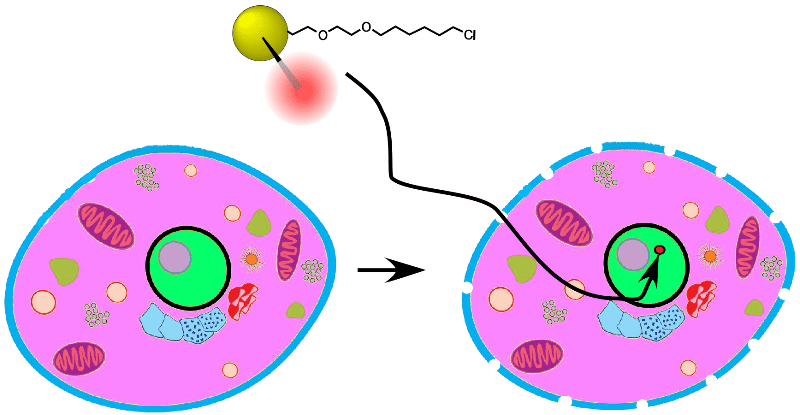
Larger versions of Ni-NTA-Nanogold® are another area of development. Since these are targeted by a metal chelate complex rather than a big targeting protein, there's room to make the gold bigger - and there are plenty of applications for a larger NTA-Ni(II) gold probe. Insertion of His tags is now feasible for a wide range of different proteins and constructs, so larger gold targeted to His tags would be a simple, versatile and effective labeling and detection reagent. At Microscopy and Microanalysis 2005, we presented preliminary results describing the preparation of a nitrilotriacetic acid - nickel (II) - 5 nm gold probe. The extended abstract of this presentation is now available as a research application on our web site.
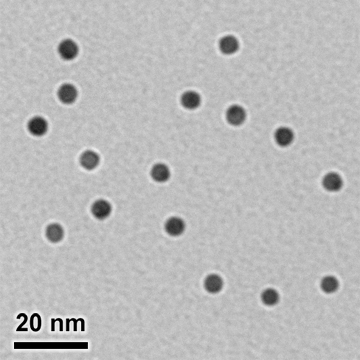
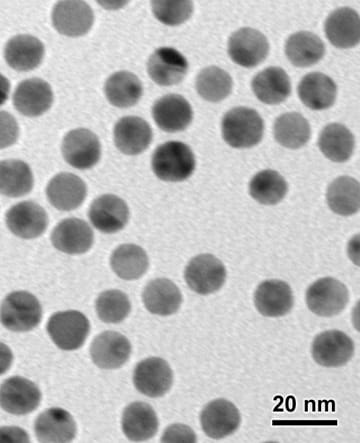
The NTA-Ni(II)-derivatized particles were prepared similarly to the NTA-Ni(II)-Nanogold particles described previously. A transmission electron micrograph is shown below, together with a chromatogram showing the formation of a new peak corresponding to the gold conjugate when the functionalized gold particles were incubated with the protein ISWI from the ACF chromatin remodeling complex, synthesized with a His tag. In a control experiment in which the NTA-Ni(II)-derivatized particles were incubated with ISWI without the 6x-His tag, virtually no binding to the protein was seen, as evidenced by the absence of the conjugate peak.
| left: Chromatogram showing new peak (arrow) when 6x-His protein (ISWI) is incubated with nitrilotriacetic acid (NTA) - Nickel (II) - 5 nm gold. Right: TEM image of functionalized 5 nm gold particles. |
References:
Keep an eye on our web site and look out for the introduction of similar reagents. In the meantime, there are options for larger gold labeling:
More information:
. . . . . . . . . . . . . . . . . . . . . . . . . . . . . . . .
To make it easier to assess the feasibility of custom syntheses and provide quotations, we have updated our guidelines.
General Information
Gold cluster and nanoparticle reagents developed by Nanoprobes, Incorporated are attached to biological molecules by covalent cross-linking, and may be used to label many molecules with suitable reactive functionalities. Our gold labels have been conjugated to proteins, lectins, oligoncleotides, peptides, lipids, biotin and cytoskeletally active probes such as modified phalloidins. If you require a gold conjugate or other molecule that is not in our catalog, we may consider preparing it as a custom synthesis or contract research project.
Our capabilities include:
Types of custom work and payment arrangements
Custom Synthesis, in which we contract to deliver a specified amount of product, is generally offered for preparations that are substantially similar to products in our catalog. These include the following reactions:
We will also be pleased to provide quotations for larger quantities or standing orders for any of our products.
Contract research, in which we contract to undertake research and require payment whether or not it produces the desired outcome, is generally necessary for conducting substantially novel procedures or preparing new entities. This might include synthesis of gold nanoparticles in alternate sizes, or with novel functionality, preparation of gold–labeled oligonucleotides, peptides, lipids or small molecules, or novel fluorescent and gold-labeled conjugates.
While we will be glad to consider such requests, our time and resources available to undertake such projects are limited. It should be noted that new syntheses frequently require more work than anticipated.
Successful Custom Syntheses
Examples of custom products that have been described in the scientific literature include:
Guidelines
Before requesting a custom synthesis quotation, we recommend that you consider our Nanogold® or undecagold labeling reagents, which you may use to label a wide variety of molecules. See p. xx for more details. We are glad to advise on the preparation of gold conjugates with other molecules that are not described in this catalog: you can contact us by telephone at 1-877-447-6266 (US & Canada) or ++(01-631) 205-9490 (others), or by e-mail at tech¤nanoprobes.com.
Please note that our researchers may not be familiar with your probe or application. We can usually respond more quickly if you tell us about the molecule you wish to label:
Terms and Conditions
Custom syntheses and contract research projects and products prepared by such projects are non-returnable and non-refundable. Products are intended for laboratory research purposes and may not be used for other purposes, including but not limited to human clinical trials or commercial purposes, specifically the resale of our Products to unaffiliated third parties without written approval from Nanoprobes.
Nanoprobes reserves all of its rights under any patents or other intellectual property rights covering the use, modification, or combination with other materials of its Products, technology or know-how. No rights, title or interest in any new products or materials developed during a custom synthesis or contract research project are granted or implied to the buyer by purchasing a product prepared as a custom synthesis, or entering into a contract for a research project.
Larger or more speculative projects in which significant patented or proprietary material, knowledge, expertise or know-how is supplied by both parties may require a separate agreement specifying disposition of rights to any discoveries, and discussion of such projects may require entering into a confidentiality agreement beforehand.
Nanoprobes has not tested any products for safety and efficacy in foods, drugs, biologics, medical devices, in vitro diagnostics, cosmetics or other clinical or human uses, unless expressly stated in our literature furnished with products.
More Information
For more information or to discuss a specific project, contact us by telephone at 1-877-447-6266 (US & Canada) or ++(01-631) 205-9490 (others), or by e-mail at tech@nanoprobes.com. Request a quotation online with our custom synthesis request form.
More information:
. . . . . . . . . . . . . . . . . . . . . . . . . . . . . . . .
Reference:
While gold nanoparticles might not be the health tonic claimed by some unscrupulous merchants, they can still have therapeutic effects, as Podsiadlo and colleagues demonstrate in their recent Langmuir paper. 6-Mercaptopurine and its riboside derivatives are some of the most widely utilized anti-leukemic and anti-inflammatory drugs, but their use is restricted by their short biological half-life and severe side effects. A new delivery method for these drugs, based on conjugation to 4-5 nm gold nanoparticles, can potentially resolve these issues. The authors found substantial enhancement of the antiproliferative effect against K-562 leukemia cells of 6-mercaptopurine-9-beta-Dribofuranoside conjugated to gold nanoparticles compared to the same drug in its typically administered free form. The improvement was attributed to enhanced intracellular transport followed by the subsequent release in lysosomes. Enhanced activity and nanoparticle carriers will make possible the reduction of the overall concentration of the drug, renal clearance, and, thus, side effects. The nanoparticles with mercaptopurine also showed excellent stability over 1 year without loss of inhibitory activity.
Reference:
In other nanoparticle news, Figuerola and group report in a recent issue of the Journal of the American Chemical Society the one-pot preparation of size-controlled bimagnetic Iron-Platinum-Iron Oxide heterodimer nanocrystals. The authors describe a one-pot, two-step colloidal strategy to prepare bimagnetic hybrid nanocrystals (HNCs), comprising size-tuned fcc FePt and inverse spinel cubic iron oxide domains epitaxially arranged in a heterodimer configuration. The HNCs have been synthesized in a unique surfactant environment by temperature-driven sequential reactions. First, FePt NCs were prepared with sizes ranging from 3 to 9 nm by the high-temperature reduction of a platinum (II) salt with Fe(CO)5 in an 1-octadecene solution containing oleic acid and oleyl amine surfactants at 170-200°C. FePt-iron oxide heterodimer HNCs were then prepared by further heating the crude reaction mixture containing the FePt NCs to 295°C (under N2) at a rate of approximately 8°C/minute. The mixture was kept at this temperature for an additional 1 hour: under these circumstances, thermal decomposition of excess iron oleate complexes in the solution led to the formation of iron oxide. After this period, the flask was allowed to cool to room temperature, then opened to air. The HNCs were precipitated upon adding 2-propanol, separated by centrifugation, and finally redissolved in either hexane, toluene, or chloroform. This self-regulated mechanism offers high versatility in the control of the geometric features of the resulting heterostructures, circumventing the use of more elaborate seeded growth techniques. It has been found that, as a consequence of the exchange coupling between the two materials, the HNCs exhibit tunable single-phase-like magnetic behavior, distinct from that of their individual components and dependent upon the relative sizes of the component domains. These properties suggest that such heterodimers may be effective contrast agents for magnetic resonance imaging techniques.
Reference:
. . . . . . . . . . . . . . . . . . . . . . . . . . . . . . . .
To unsubscribe from this newsletter, simply reply to the e-mail version, and replace the subject line with "unsubscribe." Alternatively, visit our web site newsletter page at http://www.nanoprobes.com/Newsletter.html#unsubscribe.