N A N O P R O B E S E - N E W S
Vol. 8, No. 5 May 31, 2007
Updated: May 31, 2007
In this Issue:
|
This monthly newsletter is to inform you about techniques to improve your immunogold labeling, highlight interesting articles and novel applications of metal nanoparticles, and answer your questions. We hope you enjoy it and find it useful; as always, let us know if we can improve anything.
. . . . . . . . . . . . . . . . . . . . . . . . . . . . . . . .
Ultrastructure of Lipoproteins with NTA-Ni(II)-Nanogold®NTA-Ni(II)-Nanogold® is a new type of gold probe. Instead of an antibody or protein, the targeting agent is a small metal chelate, nitrilotriacetic acid (NTA) nickel (II). This binds highly selectively to polyhistidine (His) tags; because His tags may be readily engineered into most expressed proteins, NTA-Ni(II)-Nanogold is a potential universal secondary reagent which can be used to gold-label any synthetic or expressed protein and peptide probes. |
Because of its very small size, NTA-Ni(II)-Nanogold allows the electron microscopic localization of components of macromolecular complexes at significantly higher resolution than antibody and protein probes. In their recent paper in the Biophysical Journal, Jiang and co-workers use NTA-Ni(II)-Nanogold to determine the structure of the N-terminal region of apolipoprotein B (apoB), the major protein component of very low-density lipoprotein and low-density lipoprotein, in the presence of phospholipids. Specifically, they characterized the N-terminal 6.4–17% of apoB (B6.4-17) complexed with the phospholipid dimyristoylphosphatidylcholine (DMPC) in vitro. NTA-Ni(II)-Nanogold labeling of the reconstituted lipoprotein complex followed by visualization and molecular weight determination with scanning transmission electron microscopy was used together with circular dichroism spectroscopy and limited proteolysis to determine the geometry of the B6.4-17/DMPC complex.
Protein constructs used for this study, including B6.4-10 (residues 292-469), B6.4-13 (residues 292-593), B6.4-17 (residues 292-782) and B9-13 (residues 430-593), were cloned into the pET24a vector and expressed in BL21 DE3 E. coli cells using standard protocols. Multilamellar 1,2-dimyristoyl-sn-glycero-3-phosphocholine (DMPC) suspensions were prepared by dissolving 10 mg DMPC in chloroform. This was transferred to a round bottom flask and connected to a rotary evaporator to form a uniform DMPC thin layer, and placed under vacuum for 1 hour to remove residual chloroform; the lipid was then hydrated with 5 ml 10 mM Tris, 150 mM sodium chloride, pH 7.5 (TS buffer) and gently agitated with small glass beads at room temperature to form multilamellar DMPC suspensions. To form reconstituted lipoprotein particles, B6.4-17 at 1 mg/mL was mixed with the DMPC suspension at the desired ratio in TS buffer and incubated at 24°C for at least 16 hours. B6.4-17 or B6.4-17/DMPC particles were prepared at 0.5-1 mg/ml protein concentration at the specified L/P ratios, then purified by gel filtration over a Superdex GL-200 column eluted with TS buffer at 0.5 mL/minute at 4°C. NTA-Ni(II)-Nanogold at 10 µM was incubated with 3.3 µM reconstituted B6.4-17/DMPC particles for 15 minutes at room temperature, then chromatographed over a Superdex GL-200 column eluted with TS buffer at 0.5 ml/min at 4°C to remove excess protein and NTA-Ni(II)-Nanogold from the reconstituted particles.
Scanning transmission electron microscopy imaging analysis was conducted on about 1300 individual Nanogold-labeled particles. The unmodified particles were also examined by negative stain electron microscopy: reconstituted B6.4-17/DMPC particles (4 µL) at 0.1-0.5 mg/ml (protein concentration) were loaded on a carbon-coated, glow-discharged copper grid for 1 minute, washed with 10 drops of distilled water and stained with 1% sodium phosphotungstate, pH 7.5 or NanoVan for 30 seconds. Most complexes were found to contain either two or three B6.4-17 molecules. Circular dichroism spectroscopy and limited proteolysis of these reconstituted particles indicated no large conformational changes in B6.4-17 upon lipoprotein complex formation, in contrast to the large structural changes that occur during apolipoprotein A-I-lipid interactions. The distribution of the Nanogold particles around the periphery of the discoid particles supported a model of binding in which two B6.4-1y entities are accommodated in either a head-to-tail or head-to-head arrangement, or three in a head-to-tail configuration, as shown below.
| Upper left: Structure of NTA-Ni(II)-Nanogold, showing interaction with a His-tagged protein. Upper right: Knob protein from adenovirus cloned with 6x-His tag, labeled with Ni-NTA-Nanogold, column purified from excess gold, and viewed in the scanning transmission electron microscope (STEM) unstained (Full width approximately 245 nm). Lower left: Comparison of labeling resolution for NTA-Ni(II)-Nanogold (upper) with Nanogold-labeled Fab' (lower), showing the shorter distance from the gold label to the binding site. Lower right: proposed structures and binding geometries of the B6.4-17/DMPC particle and relation to the Nanogold label position. |
This method allows a direct measurement of the stoichiometry and molecular weight of individual particles, rather than the average of the entire sample. Thus, it represents a useful strategy to characterize the structure of lipoproteins, which are not structurally uniform, but can still be defined by an ensemble of related patterns.
NTA-Ni(II)-Nanogold has several significant advantages over conventional antibody probes:
Reference:
More information:
. . . . . . . . . . . . . . . . . . . . . . . . . . . . . . . .
(a) How do I conjugate multiple targeting agents, such as proteins or peptides, to one Nanogold®?
Positively Charged Nanogold® and Negatively Charged Nanogold® both contain multiple functional groups that may be activated for cross-linking.
Positively Charged Nanogold® contains an estimated three to six amino- groups. These may be activated using a homobifunctional cross-linking reagent such as bis-(sulfo-scuccinimidyl)-suberate, or BS3, for conjugation to amino-functionalized biomolecules such as peptides via the N-terminus, or with a heterobifunctional maleimide such as (Sulfo-succinimidyl 4-[N-maleimidomethyl]cyclohexane-1-carboxylate) (Sulfo-SMCC) for conjugation to thiolated biomolecules such as thiol-modified oligonucleotides or cysteine-containing peptides or proteins.
Negatively Charged Nanogold® contains an estimated 6 to 12 accessible carboxylic acid groups. Carboxylic acid cross-linking chemistry has been extensively discussed in a previous article. The simplest and best-documented approach is to activate the carboxylic acid using either EDC/Sulfo-NHS coupling, activating with EDC (1-ethyl-3,3'-dimethylaminopropyl carbodiimide) followed by sulfo-NHS, or by treatment with CDI (N,N'-carbonyldiimidazole) in DMF (dimethylformamide). In either case, you could then react the activated ester with an amino-functionalized biomolecule, such as a peptide or amino-modified oligonucleotide.
Addressing the following considerations will help ensure a successful reaction:
While this is an effective strategy for conjugating several copies of the same entity, we do not recommend it for linking more than one type of conjugate biomolecule, or for successive conjugations of different entities. Since only one type of reactivity is incorporated into Nanogold, it is difficult to control the reaction stoichiometry to ensure that the first conjugation yields predominantly the desired conjugate, while sufficient unreacted functionalities remain for the second reaction. In addition, the reactive functionalities introduced by the cross-linker are quickly hydrolyzed: once you have activated the gold, it will be very difficult to remove either gold that has failed to react in the first step, or unconjugated biomolecule, in time for reaction with the second entity.
A better strategy in many cases is to link the three components together in a different conformation through different groups on one of the biomolecules. If one is a larger molecule that has more than one reactive functional group, then this will be the one that can support multiple attachments, and you can label it sequentially at two different sites using different cross-linking chemistries. This is how FluoroNanogold is prepared: first Monomaleimido-Nanogold is linked to a hinge thiol, then an amine-reactive fluorescent label is conjugated to an amine elsewhere in the Fab' fragment.
For example, if you wish to link both Nanogold and a peptide to an antibody, the best strategy is to first label the IgG with Monomaleimido-Nanogold, to attach the gold selectively to the hinge region. This positions the gold away from the antigen combining region, and leaves the amino- groups elsewhere on the molecule intact for the second step. Then, once you have purified the Nanogold-IgG conjugate, activate the peptide for cross-linking to amines - for example, by activating with bis-(sulfo-scuccinimidyl)-suberate (BS3) or a similar heterobifunctional cross-linker - and react this with the Nanogold-IgG. If you decide it makes more sense to position the peptide at the hinge region, you can: activate the peptide for thiol reactivity, couple to the hinge region of the reduced IgG, then label the conjugate with Mono-Sulfo-NHS-Nanogold (remember not to use thiolated reagents after Nanogold labeling, as these can displace or degrade the gold).
(b) Colloidal gold is accepted to have a charge in aqueous suspensions, and this affects many of its properties. Do Nanogold® or undecagold carry a charge, or do they ionize?
Charge affects separation methods for gold and its conjugates, including gel electrophoresis and ion exchange chromatography, and can also have a radical effect on the properties - for example, the hydrodynamic radius in solution. Therefore, it is helpful to know what charge the Nanogold® and undecagold reagents have.
Both Nanogold and undecagold are molecular coordination compounds. The gold core itself does not have any residual charge, but is fully stabilized and capped by coordinated ligands. When Monomaleimido- and Mono-Sulfo-NHS-Nanogold react as intended, they form respectively a thioether or an amide cross-link. Neither of these may be protonated or deprotonated under the conditions in which gold conjugates are stable. Labeling with Monomaleimido Nanogold will not affect the charge of the conjugate biomolecule, and therefore the only change it will impart in charge-based separation procedures is that of the added mass of the gold (although other factors may affect gel electrophoresis separation). Labeling with Mono-Sulfo-NHS-Nanogold will remove one amine from the conjugate biomolecule, and its ionization behavior will be modified accordingly.
The only charge that these molecules have is that of chemical groups that we incorporate into the coordinated ligands to impart reactivity or functionality. For example, Positively Charged Nanogold is protonated at intermediate to low pH values; Negatively charged Nanogold is deprotonated at mid to high pH values to give a negative charge. It should be noted that these are only ionized under the appropriate pH conditions: permanent ionization requires the introduction of groups bearing a permanent ionic charge, such as sulfonates or quaternary amines.
More information and help:
. . . . . . . . . . . . . . . . . . . . . . . . . . . . . . . .
| (Upper left): Live mouse, 5 minutes after injection. (Upper right) Imaging of kidney in live mouse 1 hour after injection, showing kidney contrast and fine structure (bar = 1 mm). (Lower left): Live mouse, 2 minutes after injection showing vascular fine structure (bar = 5 mm); (Lower right) MicroCT of mouse inferior vena cava (bar = 1 mm). |
AuroVist™ is a stabilized 1.9 nm gold particle. It provides better contrast than iodine for both micro-CT and clinical CT applications.* At appropriate beam energies, gold achieves a contrast up to three times greater than iodine per unit mass, yielding initial blood contrast greater than 500 Hounsfeld Units (HU). Gold concentrations up to four times those of iodine can be achieved, providing a total contrast gain of up to ten times or more. In addition, AuroVist™ gives you these enhanced performance features:
|
|
AuroVist™ is a new product, and therefore it has not been optimized in all possible applications. However, the following guidelines may be helpful in obtaining the best results with this reagent.
Best instrument and beam settings
The absorption increases by a significant factor (jump ratio) above the gold L and K edges. The X-ray properties of gold, showing the jump ratios for these regions, are shown in the table below. It is therefore advantageous to image using these absorptions. The settings below are appropriate for the different instruments.
|
|
|
How to ensure minimal toxicity
Certain strains of mice appear to be more tolerant of this gold. For Balb/C, the LD50 is ~ 3.2 g Au/kg. Nude mice and C3H mice also seem to respond about the same. Some outbred mice, however, appear to have a lower LD50 of about > 1.4 g Au/kg. If you are using outbred mice, or a different strain to those mentioned above, it is recommended that you use this lower value. The following suggestions may be helpful:
* Research use only. Not approved for clinical or human use.
References:
More information:
. . . . . . . . . . . . . . . . . . . . . . . . . . . . . . . .
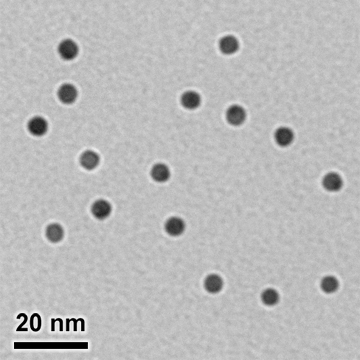
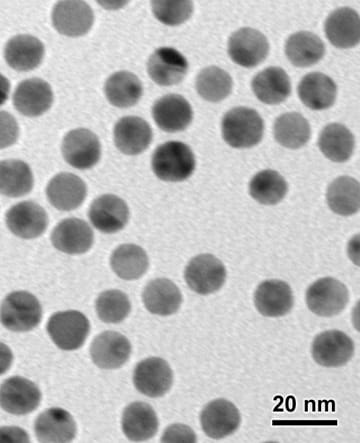
In general, the colloidal gold particles used for immunochromatographic devices are much larger than our products. Our Nanogold® particles are 1.4 nm in diameter; the colloidal gold used for immunochromatographic assays is usually 40 nm in diameter or larger. These larger particles are much more highly colored than Nanogold: consequently, relatively few are needed to form a signal that can be seen by eye once they have been captured or bound to a target on an immunochromatographic device.
Nanogold, because of its smaller size, requires autometallographic enhancement for visualization if it is used in these applications. Nanoprobes offers both silver and gold enhancement which may be used to develop Nanogold for optical observation. Once it has been developed with these reagents, Nanogold can provide significantly enhanced sensitivity: in dot blots, silver-enhanced Nanogold has demonstrated improvements of an order of magnitude or more over colloidal gold.
The simplest approach is to "develop" the device by applying the mixed reagents to it after it has been run and the gold-labeled antibody has bound to its target. However, the fabrication of an assay device in which a silver salt for silver enhancement is incorporated into the device itself, and activated when the sample is applied, has been described in the literature. The construction of such a device, and a comparison with a conventional colloidal gold lateral flow device, is shown below.
| Construction of a lateral flow device using colloidal gold (left), and colloidal gold with silver enhancement (right). |
The preparation of gold conjugates and the construction of immunochromatographic assays is a complex field in which much of the critical information is difficult to find or not publicly available. One reference which serves as a good introduction is found in IVD Technology magazine:
Because this application has not been extensively investigated with Nanogold, we do not offer a specific procedure for making Nanogold conjugates for immunochromatographic applications. We recommend antibody labeling with Monomaleimido Nanogold according to our usual protocols; the conjugate product may then be incorporated into immunochromatographic devices in the same manner as larger colloidal gold conjugates.
Reference for silver-enhanced lateral flow assay device:
Nanoprobes, Incorporated, currently does not manufacture colloidal gold. However, we have continued to make our technical support page for colloidal gold and its conjugates available as general information to the community. We are currently working to develop larger gold labeling reagents and conjugates with the same covalent, site-specific reactivity as our smaller Nanogold compounds, and have published a number of preliminary results from this work.
More information:
. . . . . . . . . . . . . . . . . . . . . . . . . . . . . . . .
If you are attending this meeting and wish to find out more about Nanoprobes, you will find us in the panel discussion titled, "Keys to Unlocking Small Business Innovation Research (SBIR) and Small Business Technology Transfer (STTR) Funding," scheduled for 11:30 am. Nanoprobes has received a number of SBIR and STTR grants from the National Institutes of Health, Department of Energy, and National Science Foundation; details can be found in our archived news releases.
More information:
. . . . . . . . . . . . . . . . . . . . . . . . . . . . . . . .
Reference:
Reference:
It is a widely known and cited paradigm that a lens-based optical microscope cannot provide resolution higher than half the wavelength of light, first advanced by Ernst Abbe in 1873. However, recent developments in fluorescence microscopy have broken this barrier, and allowed the extension of fluorescence microscopy into the nanoscale for applications such as single molecule imaging. In a recent paper in Science, Stephan W. Hell reviews the physical concepts that have enabled these advances, and suggests that fluorescence microscopy may now be extended into the domains of electron and scanning probe microscopes. Initial applications indicate that emerging technologies for far-field optical nanoscopy will have a strong impact in the life sciences and in other areas benefiting from nanoscale visualization.
Reference:
. . . . . . . . . . . . . . . . . . . . . . . . . . . . . . . .
To unsubscribe from this newsletter, simply reply to the e-mail version, and replace the subject line with "unsubscribe." Alternatively, visit our web site newsletter page at http://www.nanoprobes.com/Newsletter.html#unsubscribe.